

A growing bridal retailer had reached the point where the systems supporting the business could no longer keep up with the business itself.
What began as a relatively simple made-to-order operation had become a complex network of customers, vendors, orders, alterations, deliveries and appointments — all coordinated through spreadsheets, handwritten registers and disconnected tools.
A system built for a smaller business
The retailer’s processes had been designed around a small volume of made-to-order garments. A spreadsheet and a handwritten register were perfectly adequate when only a handful of orders were being managed each month.
Then the business changed. More customers, more made-to-order garments, more vendors, more deadlines, more moving parts. The model had shifted from primarily selling existing stock to coordinating increasingly complex made-to-order work. The underlying system had not shifted with it.
Information sat across spreadsheets, paper records, emails and separate tools. Keeping it current became steadily harder, and knowing the status of an order often meant checking several places — or asking whoever happened to know.
The process technically worked. It was simply becoming very difficult to operate.
The problem wasn’t the spreadsheet
The initial brief seemed straightforward: create a better way to track orders.
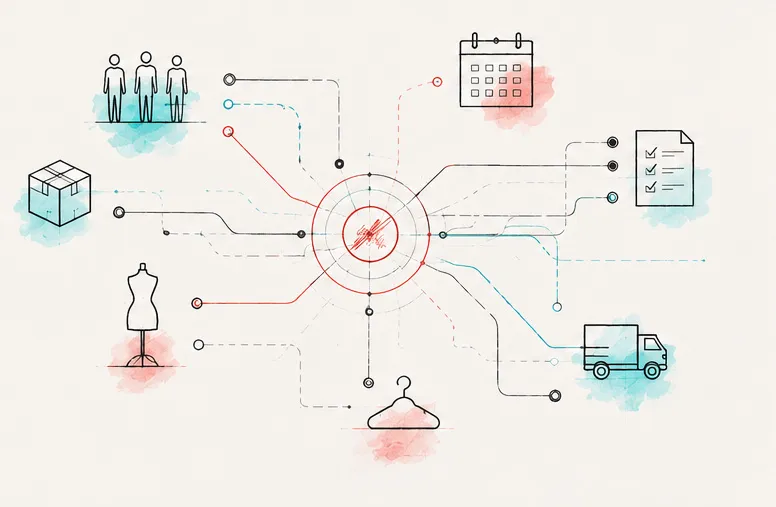
Looking more closely at how the business actually ran, order tracking turned out to be one part of something much larger. Orders were connected to customers. Customers to appointments. Orders to vendors, and vendors to delivery timelines. Finished garments to alterations, and alterations to final delivery. All of it had to stay accurate as an order moved through the business.
The opportunity wasn’t to replace a spreadsheet. It was to create a shared source of operational truth.
Start with orders, build around the business
We designed and built a web application centred on the retailer’s orders. Each order carries a single view of everything the team needs to manage it:
- Customer information
- Order details
- Vendor information
- Delivery dates
- Order status
- Payment information
- Alteration requirements
- Internal notes
For the first time, the team could see the state of an order without searching several systems or relying on one person’s knowledge.
That was only the beginning.
From order tracker to operating system
As the retailer used the system, new operational needs became apparent. Rather than introducing another disconnected tool each time a problem emerged, the application evolved alongside the business:
- Invoicing — centralising information that had previously required manual records and separate processes.
- Appointment scheduling — connecting customer appointments to the rest of the customer and order lifecycle.
- Vendor management — visibility into the vendors responsible for orders and their associated timelines.
- Courier tracking — following the movement of garments between vendors, the retailer and other destinations.
- Alterations — managing alteration requirements and tracking garments through the alteration process.
- Digital order sheets — replacing manually prepared documentation with records generated directly from the underlying data.
- Analytics — turning operational data into visibility that previously required manual compilation.
Each addition solved an individual problem. Together they created something far more valuable: a connected operating system for the business.
One system, one view of the business
What began as a solution for order tracking became the central operational platform used by the entire team. Customer information, orders, vendors, delivery timelines, alterations and appointments now exist within one connected system.
Instead of maintaining multiple records and reconciling information between disconnected tools, the team works from a shared source of information. It is used daily by every team member, and it gives management something the business previously lacked: a current snapshot of how it is operating.
Where an order once travelled from customer to paper to spreadsheet to email to vendor to register to phone and back again, customer, order, vendor, appointment, alteration, delivery and invoice now sit in one place.
The technology evolved because the business did
The most important part of this project wasn’t deciding what software to build at the outset. It was recognising that the original problem was a symptom of something larger.
The retailer didn’t need a better spreadsheet. It needed technology that reflected the complexity of the business it had become. The platform continues to evolve as new needs emerge, on the same underlying principle:
Technology should adapt as the business changes — not force the business to work around its technology.