

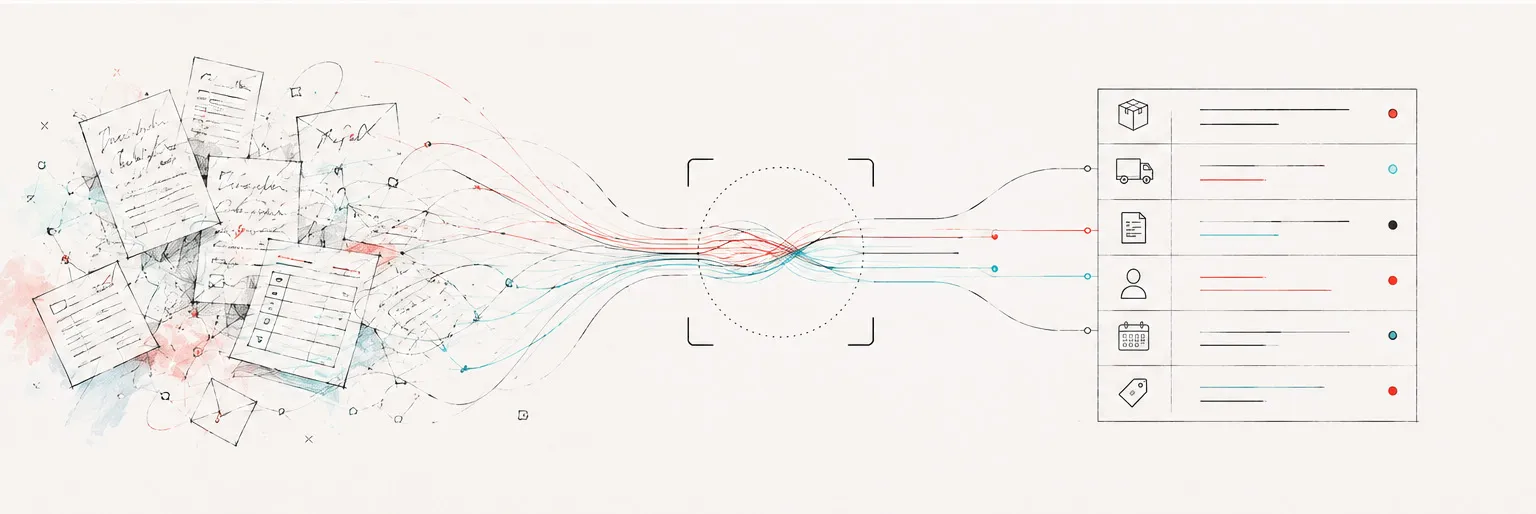
A textile importer was manually entering information from courier invoices into its internal order management system: tracking numbers, invoice numbers, vendors, items, quantities, dates and other shipment information.
The difficulty was that none of it arrived in a consistent format. Some fields were typed and others handwritten, and the documents varied in layout depending on the courier. Manual entry was slow, and every pass created another opportunity for transcription error.
Applying AI where conventional software couldn’t
We built an AI-powered document processing workflow that turns courier invoices into structured data.
A user photographs the invoice and uploads the image. The image is sent to an AI model through a cloud function, where the relevant information is identified and structured into a predictable JSON payload. That payload is then used to automatically populate the corresponding fields within the importers’s larger operational system.
Photograph → process → structured data → populate.
Less manual entry, without removing the human
Instead of reading an invoice and entering each field by hand, the system handles the tedious interpretation and provides structured information that can be reviewed and used by the larger application.
The important part isn’t that AI was used. It’s that AI was applied to a specific point of friction where conventional software couldn’t easily handle the variability of the input.
Use AI where it makes a process meaningfully easier — not simply because AI is available.